For teams running studies & trials
Build Your EMA and Biometrics Research Apps
Custom iOS + Android apps for studies and trials — ecological momentary assessment, wearable & phone biometric data, weekly progress emails, and integration with REDCap and other research tools — built to your protocol and owned by you.
Whether you run studies, trials, or validations — across academia, industry, healthcare, or the non-profit world — the app adapts to your protocol, not the other way around.
We’re not a platform you rent and bend your study to fit. We’re a development partner that builds the research app you need — with the transparency, provenance, and reproducibility research demands. 15+ years of ethically-approved, IRB-ready clinical-trial apps — including a one-year, 165-participant EMA deployment at the McGill University Health Centre.
Used in studies & trials at
McGill · Dalhousie · Saskatchewan · Oxford · Oxford Brookes · Exeter · Mayo Clinic Arizona
Founded by Professor Nancy Mayo, PhD — Distinguished James McGill Professor, Department of Medicine and School of Physical & Occupational Therapy, McGill University; Research Scientist at the Research Institute of the McGill University Health Centre (RI-MUHC), leading programs on function, disability, and quality of life. Her research anchors the science behind our apps.
How the partnership works
From study design to published findings — a genuine research partnership, not a self-serve tool.
|
1
We co-design your study protocolYour team and Professor Nancy Mayo shape the study, protocol, daily measures, and the analysis plan — built to publish. |
2
We build the appPhysioBiometrics builds your custom app and secure data storage — passive sensor capture plus daily prompts. |
3
We keep data cleanWe run the remote data capture and monitor quality throughout, so the dataset holds up to scrutiny. |
4
We help guide the analysisTrajectory models, multi-level models, and per-person time-lag analysis — turning daily data into findings. |
In the field
A one-year study at the McGill University Health Centre
We ran this model end-to-end for the Quebec Action for Post-COVID (QAPC) study, led by Distinguished James McGill Professor Nancy Mayo. Two of our apps — StepCatcher for passive daily step capture and HandHeld Monitoring for a daily symptom and activity rating — followed a cohort with post-COVID syndrome for a full year. Most EMA activity-and-symptom studies run two weeks; this one ran 52 — captured entirely remotely under an ethics-approved protocol.
|
1 year
of daily capture per participant
|
165
participants on both apps
|
~88,000
person-days captured
|
Everything this page promises is visible in that deployment — smartwatch deduplication, long-horizon continuous capture that survives months without a clinic visit, deterministic documented processing, weekly progress emails to participants, and REDCap completion tracking. StepCatcher also pairs with Heel2Toe, our clinical gait-training wearable, for biomechanical gait-quality and fall-risk metrics.
What do you need for your research or clinical trial?
Mix and match the building blocks your protocol needs — momentary assessment, wearable & phone biometrics, and participant engagement — in one app you own.
EMA & timed-survey appsBring the questionnaire to the participant as a native app on their phone — in their natural environment, at the right moment — and record exactly when each response was given. Flexible instruments — multiple choice, Likert (5/7/10-pt & custom), bounded numeric, free text — with answer-driven branching & skip logic; validated scales encode cleanly. |
Biometrics — wearable & phone dataTurn the phones and wearables your participants already own into research-grade activity and physiological data — unified, deduplicated, and fully traceable. Daily summaries on the phone — e.g., end-of-day heart rate and steps from a Garmin (or Apple Watch, Fitbit, Pixel Watch). |
Engagement & integrationsKeep participants engaged and your data clean — and connect to the research tools you already use. Weekly progress emails — each participant’s week summarised into personalised graphs and emailed out (SendGrid); feedback that drives retention. |
Purpose-built instruments, already validated
Your study doesn’t start from a blank slate. We build on proven measurement tools with a track record in peer-reviewed research — use one, combine them, or fold them into a custom app of your own.
|
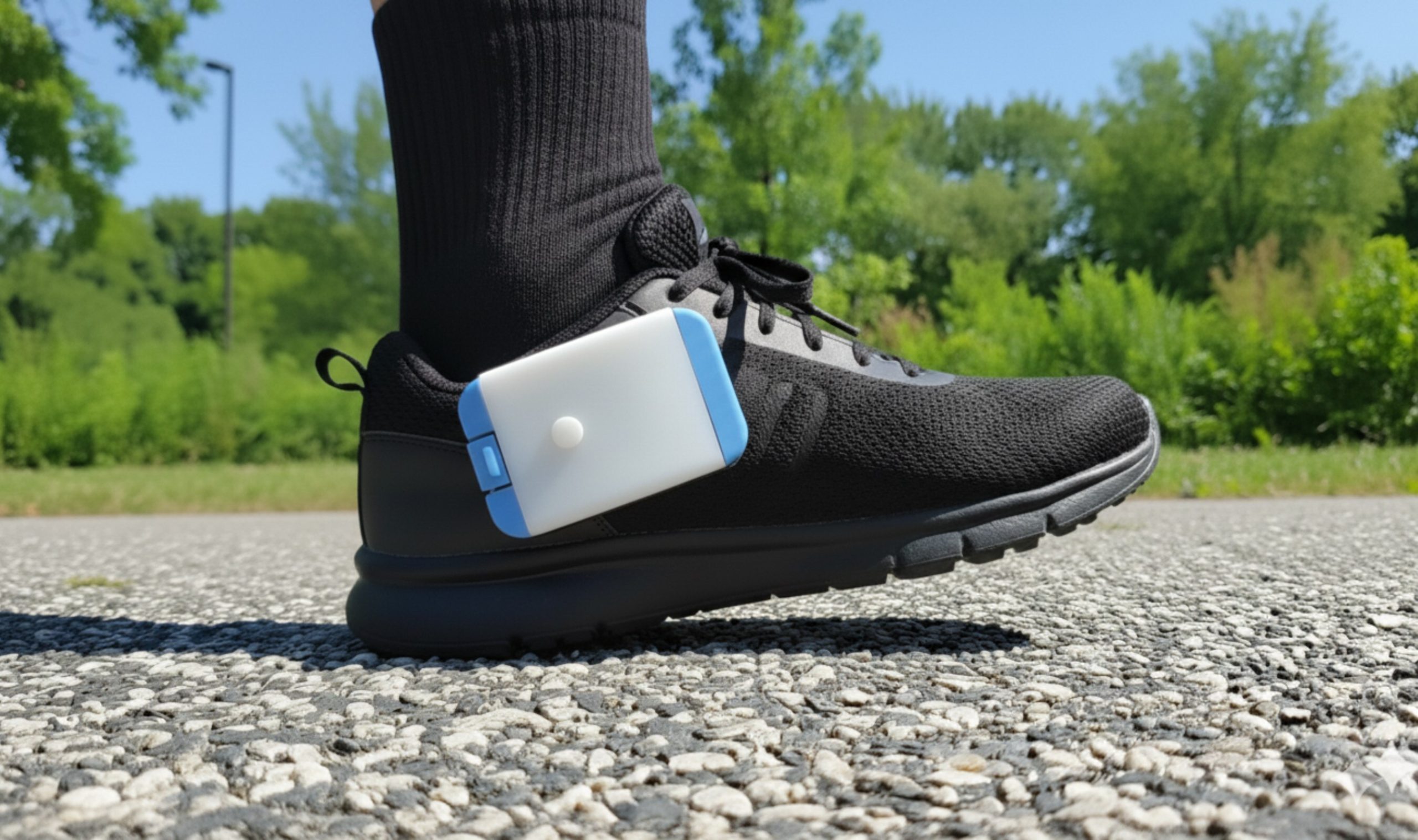
Wearable gait sensor Heel2ToeA body-worn sensor that measures the quality of walking and delivers real-time feedback. Used as an EMA instrument in research — short sessions twice a day over 30-to-90-day protocols — with findings reported in peer-reviewed papers. Objective gait quality — biomechanical walking-quality data captured in daily life, not just in the clinic. |
Passive extraction StepCatcherFuses step counts from every active source a participant has — the phone’s own sensor plus any connected watches — deduplicated into one clean daily total. No wearable? The phone alone still collects. Zero-burden — passive capture that keeps collecting for months without participant effort. |
Momentary assessment Your EMA appShort daily self-reports — symptoms, activities, and mood — delivered at the right moment on validated scales, with automatic compliance tracking. Built on our proven EMA core and branded as your own study app. One core, many studies — the same engine deployed as HandHeld Monitoring (McGill), MS Capture (Oxford), and Yoga-Fit (Dalhousie), among others. |
Why build with us, not rent a platform
Custom-built and yoursTailored to your protocol — instruments, schedule, cohorts, branding, consent — and you own the result. Transparency & reproducibility by designPublished, tunable rules; documented deduplication and source precedence; provenance on every record. You know exactly how each data point was measured — and can reproduce it. |
Deep phone-platform integrationApple Health and Google Health Connect done right — including the failure modes most teams discover too late. A real track record15+ years of ethically-approved, IRB-ready clinical-trial mobile apps and research data pipelines, in production today. |
Step capture, done properly
“Step count” sounds simple. It isn’t — the same participant produces different totals depending on the phone they carry and the watch they wear. Here’s where our step data actually comes from, and why customizable, transparent, multi-source capture beats single-device or rent-a-platform.
The phone is the hub — not the watchData flows wearable → manufacturer’s app → Apple Health (iOS) / Health Connect (Android) → our app → export. We read the health store the phone already runs — so one app ingests whichever device a participant wears, plus the phone itself. No per-brand cloud integration (Garmin Health API, Fitbit Web API) to license and maintain, and no lock-in to one brand. |
iOS and Android count differently — we model bothBoth stores hold what a source wrote and count nothing themselves, so a phone and watch both writing can double the same steps. We use each platform’s aggregate API and documented deduplication with explicit source precedence — never naïve summing — and stamp source + device on every record. |
A watch is only usable if its app feeds both health stores
| Device | Serves a mixed iPhone + Android cohort? |
| Garmin | Yes — years-stable, no Garmin API needed |
| Fitbit / Google Health | Yes — Apple Health native since 2026 |
| Withings | Yes — medical-grade HR |
| Apple Watch | iPhone only — no Android path |
| Samsung Galaxy Watch | Android only — no Apple Health path |
And when there’s no wearable at all, our app becomes its own collector from the phone’s hardware step sensor — no account, zero setup — closing the silent gaps that wreck longitudinal data.
|
Device-agnostic — Garmin, Fitbit, Withings or the phone sensor, together; no single-brand lock-in. Transparent, not a black box — published deduplication and precedence rules you can defend to a reviewer. |
Customizable — precedence order, aggregation window and thresholds set to your protocol. Reproducible — deterministic, versioned processing; the same inputs always yield the same steps. |
How we scope your study
Tell us your protocol and we’ll turn it into a working app. We’d discuss:
|
Instruments — your questionnaires and item types (we encode validated scales). Schedule — prompt frequency, time windows, study duration, phase structure. Sampling strategy — fixed-interval, signal-contingent, or event-contingent. |
Data sources — Apple Health, Health Connect, wearables, or app-collected. Cohorts — study arms and assignment. Data, compliance & consent — exports, adherence metrics, and your institution’s IRB/ethics requirements. |
If you can describe your protocol, we can build it.
Who gets prompted, when, how often, with what questions, and from which devices — tell us, and we’ll scope and cost it.
sales@physiobiometrics.com · physiobiometrics.com